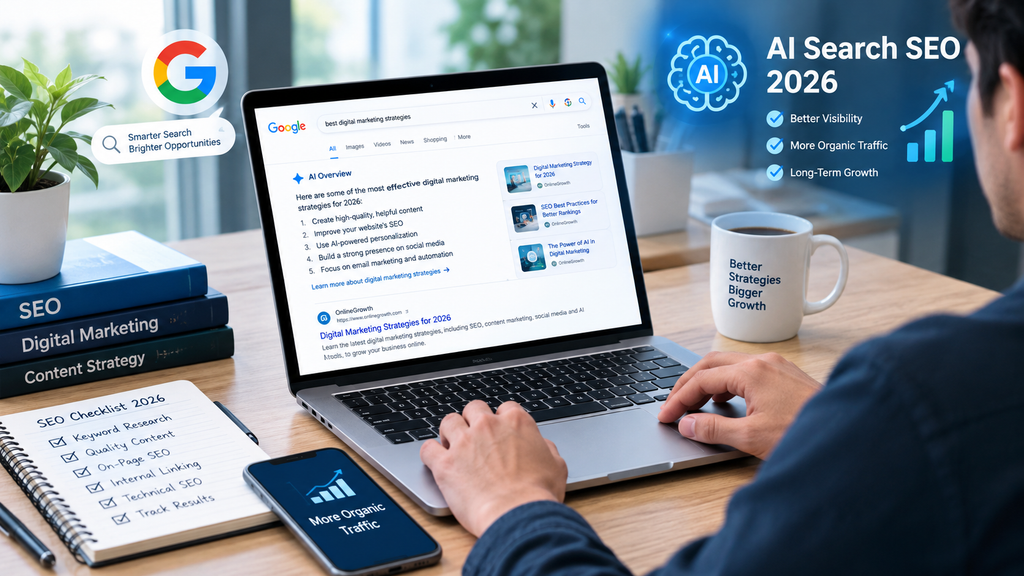
Google Search is evolving. People are using AI-powered search experiences to discover information, compare solutions, and explore topics in greater depth. For website owners, this creates new opportunities to reach relevant audiences—but it also makes high-quality content more important than ever.
If you run a blog, digital marketing agency, or online business, you need an SEO strategy that focuses on more than just keywords.
In this guide, OnlineGrowth explains how AI search is changing SEO in 2026 and shares practical ways to improve your website’s visibility, attract organic visitors, and build long-term search traffic.
What Is AI Search SEO?
AI search SEO is the practice of improving a website’s visibility in search experiences that use artificial intelligence, alongside traditional search results.
Google’s AI Overviews and AI Mode can help users explore questions and discover relevant websites. These experiences may display links to pages that support or expand on an answer.
However, AI search optimization does not replace traditional SEO. Google continues to rely on its core search systems and established SEO practices to find and evaluate useful web content.
For website owners, the goal is simple: publish original, relevant, trustworthy information and make sure search engines can discover and understand it.
1. Focus on Search Intent Instead of Just Keywords
Keyword research remains a fundamental part of SEO, but understanding why someone searches is equally important.
For example, a person searching for “what is SEO” probably wants a beginner-friendly explanation. Someone searching for “best SEO tools for small businesses” is more likely to want comparisons, features, and pricing information.
Before writing an article, identify the search intent behind your target keyword.
Consider these common types of search intent:
- Informational: Users want to learn something.
- Commercial: Users are comparing products or services.
- Transactional: Users are ready to take action or make a purchase.
- Navigational: Users want to find a specific website or brand.
Review the search results for your target query to understand what readers expect. Then create content that answers their questions more clearly and thoroughly.
OnlineGrowth tip: Choose one primary search intent for each article. This helps you create focused content instead of trying to answer every possible question on one page.
2. Create Original, Helpful Content
AI tools can make content production faster, but publishing large quantities of generic articles is not a reliable SEO strategy.
Google’s guidance emphasizes valuable, unique content that provides something useful beyond information already available elsewhere.
To make your content stand out, include:
- Original examples from your own work.
- Practical steps readers can follow.
- Screenshots, demonstrations, or original visuals where relevant.
- Expert commentary and carefully verified facts.
- Clear explanations of complex concepts.
- Updated information when tools or strategies change.
For example, instead of publishing another generic article about keyword research, create a practical tutorial showing how to research keywords for a real website, evaluate search intent, and organize the results into a content plan.
The more useful your article is to its intended audience, the more reason readers have to visit and engage with your website.
3. Optimize Your Website for AI Search Experiences
AI-powered search introduces new ways for people to discover websites. You can improve your site’s readiness by following established SEO fundamentals.
Start with these steps:
Use descriptive headings. Organize your article with clear H2 and H3 headings that explain what each section covers.
Answer questions directly. Provide a concise explanation near the beginning of each relevant section, followed by supporting details and examples.
Use accurate information. Verify factual claims and reference trustworthy sources when appropriate.
Keep important information in text. Do not hide essential explanations inside images or inaccessible interactive elements.
Build a logical internal linking structure. Link related articles so visitors and search engines can discover useful pages.
Maintain technical accessibility. Make sure important pages can be crawled and are eligible for indexing.
You do not need special AI-only keywords, an invented ranking formula, or a separate AI writing style to appear in Google’s AI search features. Standard SEO best practices remain the foundation.
4. Improve On-Page SEO
On-page SEO helps search engines and readers understand what a page is about.
Before publishing an article, review the following elements.
SEO title
Write a descriptive title that communicates the article’s main benefit and topic.
Example: “AI Search SEO in 2026: How to Get More Google Traffic”
Meta description
Create a concise, accurate summary that encourages relevant searchers to visit your page.
Example: “Learn how to improve Google rankings and organic traffic in 2026 with AI search SEO, helpful content, keyword research, and practical optimization tips.”
Google may generate a different search-result snippet depending on the query, so a meta description does not guarantee that exact text will appear.
URL structure
Use a short, descriptive URL that reflects the page’s topic.
Example: /ai-search-seo-google-traffic-2026/
Heading structure
Use one clear main heading and organize the article into meaningful sections. Headings should help readers navigate the content naturally.
Images and accessibility
Use relevant images that support the article. Add descriptive alt text when an image conveys useful information, and compress image files to help maintain good page performance.
Internal links
Link to related pages on your own website using descriptive anchor text. Avoid adding links that do not help the reader.
These improvements make your content easier to understand and use, while supporting a consistent SEO strategy.
5. Build Topic Authority With Content Clusters
Publishing one article is rarely enough to establish strong coverage of a competitive subject.
A content cluster is a group of related articles that cover a topic from different angles and link to one another where appropriate.
For an SEO and digital marketing website such as OnlineGrowth, a content cluster could include:
Main guide: AI Search SEO in 2026
Supporting articles:
- How to Do Keyword Research for Beginners
- On-Page SEO Checklist for New Websites
- How to Use Google Search Console
- Best Free SEO Tools for Small Businesses
- How to Improve Website Indexing
- SEO Content Writing Tips That Help Readers
- How to Track Organic Traffic and Conversions
- Common Technical SEO Mistakes and How to Fix Them
Publish the supporting articles over time and link them to the main guide when relevant.
This approach helps readers explore a subject in depth and creates a more organized website structure.
Do not publish every article simply to reach a particular content count. Each page should have a clear purpose and provide distinct value.
6. Use Google Search Console to Find Traffic Opportunities
Google Search Console is a valuable free resource for understanding how your website performs in Google Search.
It helps you evaluate search queries, impressions, clicks, click-through rates, and average search positions.
Use it to identify opportunities such as:
Pages with many impressions but few clicks: Review the title, snippet, and alignment with search intent.
Pages ranking for relevant queries: Improve the content where it would genuinely help readers, and add useful internal links.
Pages that are not indexed: Investigate technical issues, canonical settings, crawling accessibility, and other indexing factors.
Articles losing visibility: Check whether the content is outdated, less useful than competing pages, or affected by technical changes.
Do not change a page simply because its position fluctuates for a short period. Review performance over an appropriate time range and investigate before making major changes.
For AI-related search visibility, also review the reporting and controls available in your Search Console account.
7. Make Website Speed and Mobile Experience a Priority
Useful content needs a website experience that does not frustrate visitors.
A slow or difficult-to-use website can make it harder for people to access information, navigate between pages, or complete important actions.
Improve the user experience by:
- Choosing reliable hosting.
- Compressing large images.
- Removing unnecessary scripts and plugins.
- Using a responsive design.
- Making navigation clear on mobile devices.
- Checking important pages for layout problems.
- Monitoring Core Web Vitals and other page experience indicators.
Website speed alone does not guarantee higher rankings. Treat performance as part of a broader strategy that combines helpful content, technical accessibility, and a positive user experience.
8. Use AI Tools Without Sacrificing Content Quality
AI tools can support many SEO tasks, including brainstorming, creating outlines, grouping keywords, drafting title ideas, and identifying questions to investigate.
A practical workflow looks like this:
Step 1: Research. Identify your audience, target queries, and the information readers need.
Step 2: Create an outline. Organize the main questions into a logical structure.
Step 3: Draft the content. Use AI assistance where it saves time, but include your own knowledge and original examples.
Step 4: Fact-check. Verify statistics, product details, claims, and external references.
Step 5: Edit for usefulness. Remove repetition, clarify confusing explanations, and make sure the article delivers on its promise.
Step 6: Publish and measure. Monitor indexing, search performance, engagement, and conversions.
AI-generated content is not automatically a problem for SEO. The risk is producing content at scale without adequate originality, accuracy, or value for readers.
Use automation to improve your process, not to replace editorial judgment.
9. A Simple 30-Day SEO Plan for OnlineGrowth
You can start improving your SEO without trying to implement every technique at once.
Week 1: Research and audit
- Identify your main audience and website goals.
- Review your existing blog posts.
- Research relevant keywords and search intent.
- Check Google Search Console for indexing issues.
- Select a manageable list of article topics.
Week 2: Publish one strong article
- Create an original, well-structured guide.
- Optimize its title, meta description, and URL.
- Add useful internal and external links.
- Include relevant images with descriptive alt text.
- Check the page on mobile devices.
Week 3: Build supporting content
- Publish a related tutorial or checklist.
- Link relevant articles to one another.
- Share useful excerpts through your social channels.
- Update older articles when you identify meaningful improvements.
Week 4: Measure and improve
- Review impressions, clicks, and search queries.
- Identify pages with potential for improvement.
- Check technical and indexing issues.
- Record your results and plan the next month’s content.
SEO results vary by website, competition, content quality, and many other factors. A 30-day plan helps you build a consistent process; it does not guarantee first-page rankings or a specific traffic increase.
Common SEO Mistakes to Avoid in 2026
Avoid these mistakes when building your organic traffic strategy:
- Publishing generic AI-generated articles without meaningful review.
- Repeating the same keyword unnaturally throughout a page.
- Creating multiple pages that target the same intent without a clear reason.
- Buying links or creating manipulative backlinks.
- Using misleading titles that do not match the content.
- Ignoring internal links and technical indexing problems.
- Making unsupported claims or publishing unverified statistics.
- Expecting immediate results from a newly published article.
- Following SEO advice that promises guaranteed rankings.
Sustainable growth comes from understanding your audience, publishing useful information, and improving your website based on evidence.
Frequently Asked Questions
What is the best SEO strategy for 2026?
Focus on understanding search intent, creating original and helpful content, maintaining technical SEO, improving internal links, and measuring performance through Google Search Console.
How can I get more organic traffic from Google?
Research relevant search queries, publish useful content, improve your website’s technical health, optimize page titles and descriptions, and update existing pages when you have a meaningful reason to do so.
Does AI-generated content rank on Google?
AI-assisted content can appear in search results when it meets Google’s applicable policies and provides value. Automatically generating large amounts of low-value content can violate Google’s scaled content abuse policy.
What is the difference between SEO and GEO?
SEO is the broader practice of improving a website’s visibility in search engines. GEO, or generative engine optimization, is a term used for strategies intended to improve visibility in generative AI experiences. Google’s guidance emphasizes that foundational SEO practices remain important for AI search.
How long does SEO take to work?
There is no fixed timeline. Results depend on competition, website history, technical health, content quality, and other factors. Measure progress over time instead of relying on a guaranteed ranking date.
Is Google Search Console free?
Yes. Google Search Console is a free Google service that helps website owners monitor search performance, inspect indexing, and identify certain technical issues.
Final Thoughts
SEO in 2026 is about helping people find the information they need, whether they discover it through traditional search results or AI-powered search experiences.
For OnlineGrowth, the best path forward is to build a focused library of helpful digital marketing guides, use keyword research to understand reader needs, and continuously improve content based on real performance data.
Start with one excellent article, connect it to relevant resources on your website, and use what you learn to guide your next publication.
Want to grow your website with smarter SEO strategies? Explore more practical digital marketing guides on OnlineGrowth and keep building your online presence.